Jet-Milled vs. Stone-Ground Matcha: Which is Better for Commercial Use?
A definitive technical guide comparing traditional stone-ground matcha with modern water-cooled jet-milled matcha powder, exploring particle size physics, heat control, throughput, cost efficiency (COGS), and commercial application matching.
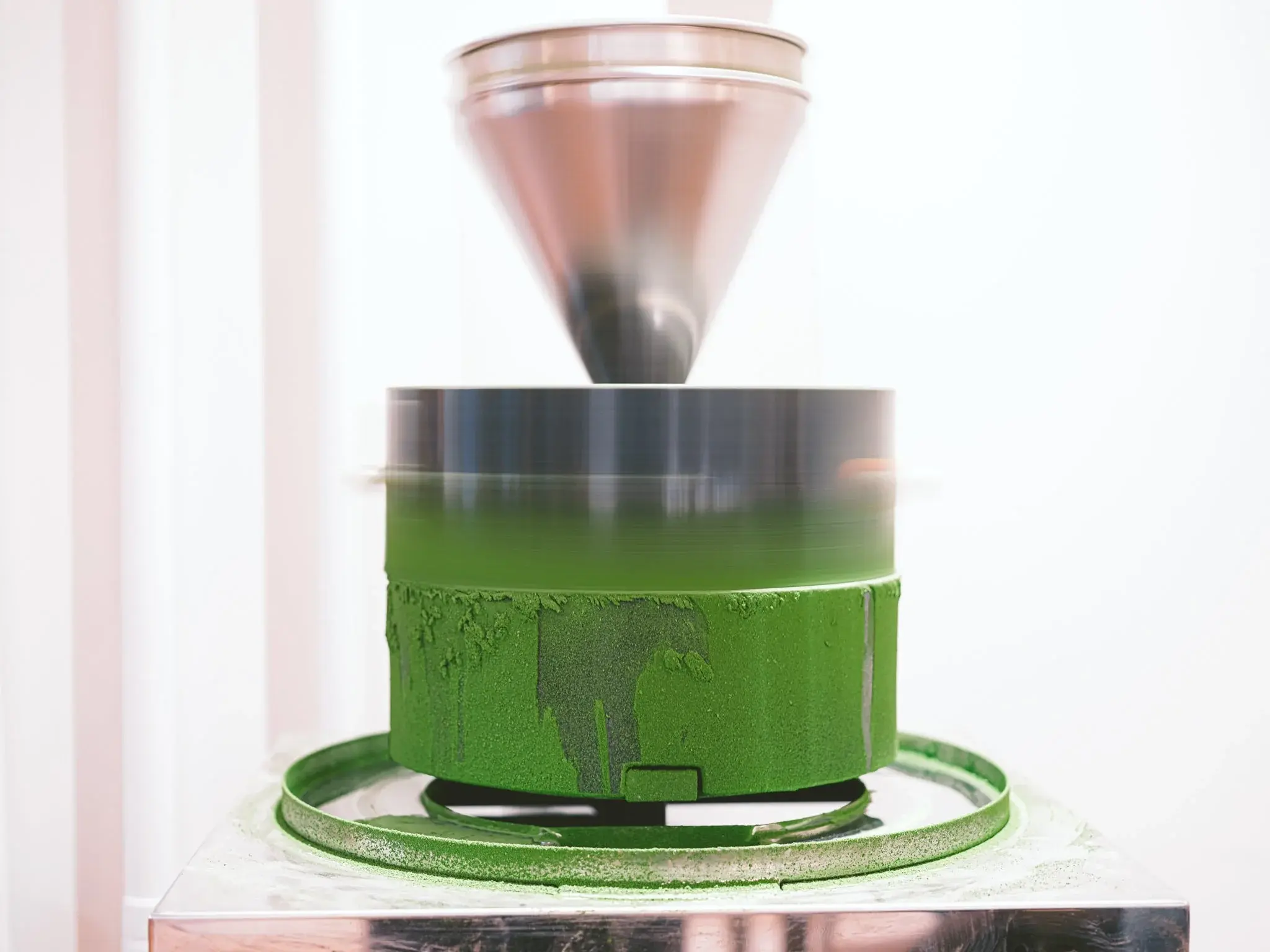
Table of Contents
Looking for Bulk Premium Matcha Powder?
Evaluate our premium shade-grown matcha grades (Ceremonial, Premium, and Culinary) in your own lab or kitchen.
For global beverage chains, food developers, and matcha brand owners, selecting the right wholesale matcha powder involves more than evaluating leaf origin or harvest timing. One of the most critical—yet frequently misunderstood—factors that dictates particle suspension, color retention, mouthfeel, and Cost of Goods Sold (COGS) is the milling technology used to grind Tencha (dried leaf flesh) into powder. In the wholesale market, two primary formats dominate: Traditional Stone-Ground Matcha and Modern Water-Cooled Jet-Milled Matcha. While stone-ground matcha carries immense heritage and prestige, jet-milled matcha has emerged as the industrial backbone for commercial beverages and food manufacturing. This technical guide explores the physical mechanics, heat transfer dynamics, throughput metrics, and application matching for both milling technologies to help B2B buyers make the most strategic procurement decisions.
1. The Physics of Matcha Milling: Particle Size, Heat & Chlorophyll Integrity
To evaluate milling performance objectively, food engineers and procurement teams must look at three physical and chemical dynamics that occur during leaf pulverization:
- Particle Size Distribution (D90): Matcha is not water-soluble; it forms a suspended colloidal solid in liquid. According to Stokes' Law, reducing particle diameter (r) quadratically slows settling velocity. Achieving a micro-fine particle size (under 10 microns) is essential for a velvety mouthfeel and long-term suspension stability.
- Thermal Friction & Oxidation: Mechanical grinding generates friction heat. If the milling zone temperature exceeds 40°C to 45°C, delicate chlorophyll pigments undergo rapid pheophytinization (turning dull yellow-brown), while volatile L-theanine and fresh shade aromas (ooika) evaporate.
- Particle Morphology: The shape of the pulverized powder (rounded vs. angular/irregular) affects how light reflects off the dry powder and how particles interact on the human tongue.
2. Traditional Stone-Ground Matcha: The Ceremonial Standard
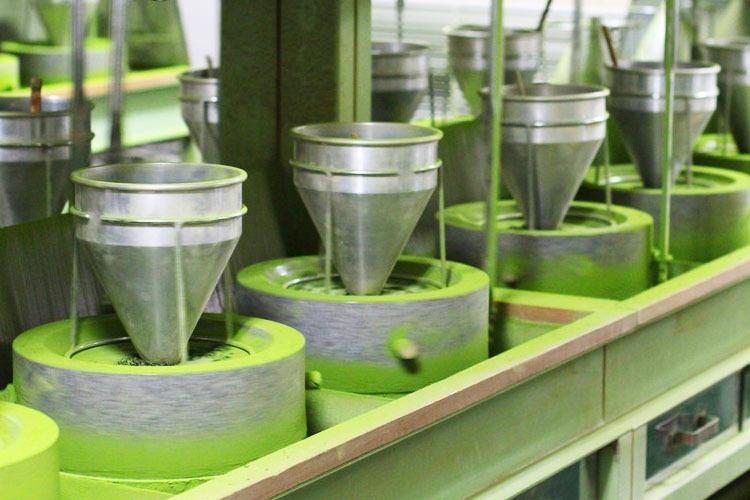
Stone grinding is the traditional method preserved for centuries since the Song Dynasty and refined in Uji, Japan. Tencha flakes are fed through a central hopper between two custom-grooved granite stones rotating slowly at 30 to 40 RPM.
Advantages of Stone-Ground Matcha
- Minimal Thermal Stress: Because the stones rotate extremely slowly, friction heat is minimal, preserving delicate amino acids and producing a bright, "electric" jade green color.
- Spherical Particle Morphology: The gentle shearing and crushing action of smooth granite grooves creates rounded, smooth particles (5–8 microns) that whisk into a rich, velvety micro-foam with zero astringent bite.
- Unmatched Heritage Storytelling: For high-end retail brands selling ultra-premium Wholesale Ceremonial Grade Matcha Powder, stone-ground processing provides a compelling cultural narrative that commands high retail margins.
Commercial B2B Limitations
- Extremely Low Throughput: A single granite mill produces only 30 to 40 grams of powder per hour (approx. 700g to 1kg per 24-hour day). Scaling up to tons of monthly bulk demand requires thousands of individual mills, creating massive capital overhead.
- High Unit Cost (COGS): The low yield and high maintenance required to re-groove granite stones directly inflate the cost per kilogram, making 100% stone-ground matcha cost-prohibitive for mass-market lattes, RTD canning, and baking.
3. Modern Water-Cooled Jet-Milled Matcha: The Industrial Powerhouse
Jet milling (fluidized bed jet pulverization) represents the modern evolution of matcha processing. High-pressure streams of purified air accelerate Tencha flakes inside a stainless-steel grinding chamber, causing leaf particles to collide with one another at supersonic speeds and shatter into micro-fine powder.
Thermal Innovation: Water-Cooling Jackets
A common misconception is that mechanical jet milling burns the tea powder due to high speed. While early uncooled pin mills or hammer mills did overheat tea, state-of-the-art industrial jet mills utilize chilled water-cooling jackets (2°C to 4°C) surrounding the collision chamber and classification rotor. This maintains processing temperatures strictly below 38°C, completely eliminating heat-induced browning and preserving volatile flavor compounds.
Advantages of Jet-Milled Matcha
- Micro-Fine Particle Consistency (D90 < 8μm): Built-in air classifiers continuously separate pulverized particles, allowing only micro-fine powder (5–8 microns) to pass into the collector while returning larger flakes for re-milling. This delivers exceptional liquid suspension. (Read more in our guide on Formulating RTD Matcha Beverages.)
- Massive Industrial Scale: A single commercial jet mill unit produces 20kg to 50kg of micro-fine matcha per hour, easily fulfilling multi-ton orders for global cafe chains and RTD manufacturers without supply bottlenecks.
- Optimized Procurement Cost (COGS): High production efficiency reduces processing costs by 40% to 60% compared to stone grinding, allowing B2B buyers to secure vibrant, high-grade matcha at competitive wholesale prices.
4. B2B Comparison Matrix: Stone-Ground vs. Jet-Milled Matcha
The table below summarizes key technical parameters to assist procurement and R&D teams in selecting the optimal milling specification:
| Specification / Parameter | Stone-Ground Matcha | Water-Cooled Jet-Milled Matcha |
|---|---|---|
| Primary Grinding Mechanism | Slow shearing & crushing between stone grooves | High-velocity particle-to-particle air collision |
| Average Particle Size (D90) | 5.0 – 8.0 microns | 5.0 – 8.0 microns (Air-Classified) |
| Processing Temperature | Ambient slow friction (< 35°C) | Chilled water jacket controlled (< 38°C) |
| Hourly Production Yield | 30g – 40g / hour per mill unit | 20kg – 50kg / hour per mill line |
| Color & Chlorophyll Retention | Vibrant Jade Green (100% retention) | Vibrant Jade Green (98–100% retention) |
| Liquid Suspension Performance | Smooth suspension for fresh whisking | Exceptional suspension in lattes & RTD liquids |
| Relative Wholesale Cost (COGS) | High (Premium Ceremonial Pricing) | Highly Cost-Effective (30–50% savings) |
5. Commercial Application Matching Guide
To achieve the best balance between sensory quality and raw ingredient budget, product formulators should match milling technology to their specific commercial application:
A. Single-Origin Ceremonial Pure Drinking Matcha → Stone-Ground Matcha
If your brand targets high-end tea connoisseurs who whisk matcha straight with 80°C water (Usucha/Koicha) and pay a premium for origin heritage, choose Granite Stone-Ground Wholesale Ceremonial Grade Matcha Powder.
B. Commercial Cafe Chain Lattes & Flavored Teas → Water-Cooled Jet-Milled Matcha
For high-volume cafe chains serving iced lattes, oat milk matcha, and flavored beverages, Water-Cooled Jet-Milled Bulk Premium Grade Matcha Powder Supplier is the ideal solution. It delivers a brilliant green appearance, smooth mouthfeel, and robust tea flavor that cuts through milk fat while keeping ingredient cost under $0.10 per serving. (Learn more about latte cost breakdowns in Commercial Matcha Latte Formulation.)
C. Ready-to-Drink (RTD) Canned & Bottled Lines → Ultra-Fine Jet-Milled Matcha
RTD beverage manufacturers require a particle size of 5 to 8 microns (D90 < 8μm) combined with hydrocolloid stabilization to prevent sedimentation in cans over a 12-month shelf life. Water-cooled jet milling offers the precise particle classification required for industrial filling lines.
D. Bakery, Confectionery & Frozen Desserts → Industrial Jet-Milled Matcha
For cookies, cakes, chocolates, and ice cream, heat-stable Jet-Milled Bulk Culinary Grade Matcha Powder Wholesale provides maximum color density and tea flavor at a scale and price point tailored for food factory production. (Read about baking chemistry in The Chemistry of Matcha in Baking.)
Partner with Orisen Tea for Custom Milling & Free Sample Evaluation
Hunan Orisen Biotech Co., Ltd. (Orisen Tea) operates both traditional granite stone milling rooms for ultra-premium ceremonial grades and advanced water-cooled jet milling lines for commercial bulk supply. Operating our own high-altitude shade-grown tea gardens in Hunan, China, we supply 100% pure, traceable matcha certified under FDA, USDA Organic, EU Organic, ISO22000, and Halal standards.
Unsure which milling technology fits your formula best? Contact our technical sales team today to request a Free Side-by-Side B2B Sample Kit comparing Stone-Ground and Jet-Milled grades for your R&D evaluation.
FAQ: Jet-Milled vs. Stone-Ground Matcha
Q1: Does jet milling damage the L-theanine or EGCG content of matcha?
No. When jet milling is equipped with water-cooling jackets (keeping temperatures below 38°C), chemical analysis confirms that L-theanine, EGCG, and chlorophyll levels remain identical to stone-ground powder from the same batch of Tencha.
Q2: Why is stone-ground matcha so much more expensive than jet-milled matcha?
The price difference is driven entirely by production yield. A stone mill produces only ~30g per hour, requiring significant labor, space, and equipment maintenance. A jet mill produces 20kg–50kg per hour with automated air classification, dramatically reducing manufacturing costs per kilogram.
Q3: Can we request custom mesh or micron sizes for our industrial order?
Yes. Orisen Tea can adjust the air classifier settings on our jet milling lines to supply custom particle size distributions (e.g., D90 < 6μm for delicate RTD drinks, or D90 < 12μm for industrial bakery applications) to match your manufacturing process.
Interested in Sourcing Premium Matcha Powder?
Hunan Orisen Biotech Co., Ltd. is a certified factory source. Contact us for bulk wholesale pricing, custom formulation, or OEM private label packaging.
Related Articles
Matcha vs. Green Tea Powder: What's the Difference for Food Manufacturers?