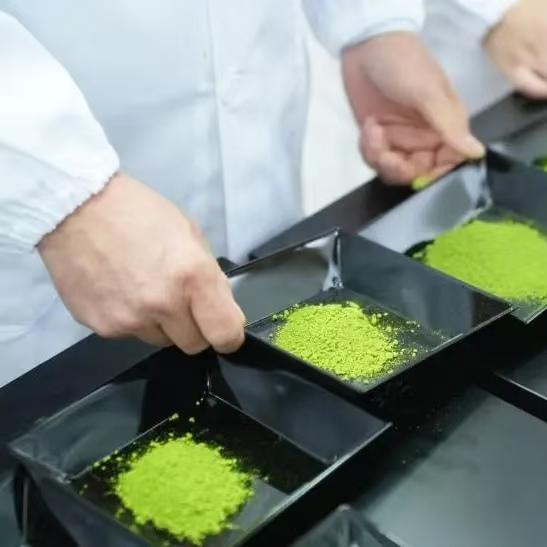
Global Matcha Compliance Guide: Navigating Pesticide MRLs and Heavy Metal Limits for US FDA and EU Markets
A comprehensive B2B technical guide for food manufacturers, beverage brands, and dietary supplement companies on navigating pesticide MRLs (FDA vs. EU), heavy metal limits, and compliance verification in bulk matcha sourcing.

Table of Contents
Looking for Bulk Premium Matcha Powder?
Evaluate our premium shade-grown matcha grades (Ceremonial, Premium, and Culinary) in your own lab or kitchen.
For global food manufacturers, beverage brands, and dietary supplement companies, sourcing bulk matcha powder is a highly lucrative but regulatory-sensitive endeavor. Because matcha is a powdered product made by grinding the entire shade-grown tea leaf, consumers ingest 100% of the leaf tissue. Consequently, food safety authorities worldwide enforce exceptionally strict limits on chemical residues and contaminants. Navigating the complex web of Pesticide Maximum Residue Limits (MRLs) and heavy metal compliance is the single most critical factor in preventing customs detentions, product recalls, and brand damage. This comprehensive B2B guide provides procurement managers and R&D teams with a detailed analysis of the regulatory standards in the United States and the European Union, along with actionable strategies to secure a fully compliant supply chain.
1. The Regulatory Landscape: US FDA vs. EU EFSA Standards
The two largest markets for wholesale matcha—the United States and the European Union—have fundamentally different regulatory frameworks for food safety. Understanding these differences is crucial for compliance planning:
- United States (FDA & EPA): In the US, the Environmental Protection Agency (EPA) establishes pesticide tolerances for food commodities, while the Food and Drug Administration (FDA) enforces these tolerances at ports of entry. The FDA utilizes import alerts and random sampling to test incoming shipments.
- European Union (EFSA & EC): The European Food Safety Authority (EFSA) and the European Commission enforce some of the strictest food safety standards globally. The EU operates on a precautionary principle. If a specific pesticide does not have an established MRL for tea, the EU applies a strict default limit of 0.01 mg/kg. This "one-size-fits-all" default limit means that even trace amounts of a pesticide can lead to a shipment being rejected and flagged on the Rapid Alert System for Food and Feed (RASFF).
2. Heavy Metal Limits in Bulk Matcha
Tea plants (Camellia sinensis) are bioaccumulators, meaning their roots naturally absorb minerals and metals from the soil. Heavy metal contamination typically originates from soil chemistry, industrial pollution near tea gardens, or coal-fired heating during processing. The table below outlines the maximum allowable limits for key heavy metals in the US and EU markets:
| Heavy Metal | US FDA / EPA Guidance | EU EFSA Limit | Orisen Tea Standard |
|---|---|---|---|
| Lead (Pb) | < 2.0 mg/kg (general food limit) | < 3.0 mg/kg (Regulation EC 1881/2006) | < 1.0 mg/kg (Strict Export Grade) |
| Arsenic (As) | < 0.5 mg/kg (recommended) | < 0.2 mg/kg | < 0.1 mg/kg |
| Cadmium (Cd) | < 0.3 mg/kg | < 0.2 mg/kg | < 0.1 mg/kg |
| Mercury (Hg) | < 0.1 mg/kg | < 0.02 mg/kg | Non-detectable (< 0.01 mg/kg) |
3. Navigating Pesticide MRLs: The B2B Sourcing Challenge
Pesticide compliance is the most common hurdle in global matcha trade. Because tea leaves are not washed after harvesting (steaming and drying occur immediately), any pesticide applied in the garden remains on the leaf. For B2B buyers, there are three critical pesticide categories to monitor:
- Anthraquinone: Often detected in tea, anthraquinone is not a pesticide but a byproduct of coal or wood combustion during the drying process. The EU enforces an extremely low MRL of 0.02 mg/kg for anthraquinone in tea. To comply, manufacturers must use clean energy drying systems (such as electricity, natural gas, or biomass pellet heating) rather than traditional coal-fired ovens.
- Glyphosate: A widely used herbicide. The EU MRL for glyphosate in tea is 2.0 mg/kg, while the US EPA tolerance is 1.0 mg/kg. For organic certified matcha, glyphosate must be completely non-detectable.
- Neonicotinoids (e.g., Acetamiprid, Imidacloprid): These systemic insecticides are commonly used in agriculture but are subject to strict limits. The EU MRL for acetamiprid in tea is 0.1 mg/kg, and for imidacloprid, it is 0.05 mg/kg.
4. How to Audit and Verify Supplier Test Reports
B2B buyers should never rely solely on a supplier's self-issued Certificate of Analysis (COA). A robust compliance verification audit must include the following steps:
- Demand Third-Party Lab Reports: Request batch-specific test reports from internationally accredited laboratories such as SGS, Eurofins, or Intertek. The report must be issued within the last 6 months.
- Verify the Testing Method: Ensure the laboratory used official testing methods, such as LC-MS/MS (Liquid Chromatography-Tandem Mass Spectrometry) and GC-MS/MS (Gas Chromatography-Tandem Mass Spectrometry), which are capable of detecting residues down to 0.01 mg/kg.
- Check the Pesticide Screen Scope: Standard pesticide screens only test for 50 to 100 compounds. For EU compliance, request a Multi-Residue Screen (MRS) covering at least 500+ pesticide compounds.
- Match Batch Numbers: Verify that the batch number on the SGS/Eurofins report matches the batch number on the COA, the commercial invoice, and the physical packaging labels.
5. Orisen Tea's Quality Control and Compliance Framework
At Hunan Orisen Biotech Co., Ltd. (Orisen Tea), we have built our reputation on providing 100% compliant, export-grade bulk matcha. Our vertically integrated supply chain controls quality from soil to shipment:
A. Soil and Water Pre-Screening
Before establishing our shade-grown tea gardens in the high-altitude regions of Hunan, China, we conduct comprehensive soil and water testing. We select regions with pristine ecological environments, far from industrial centers, ensuring that heavy metal baselines in the soil are well below international limits.
B. Integrated Pest Management (IPM)
We minimize chemical inputs by employing advanced IPM techniques in our gardens:
- Physical Controls: Yellow sticky traps and solar-powered insect-killing lamps are installed throughout the fields to control pests naturally.
- Biological Controls: We introduce natural predators (such as ladybugs and predatory mites) to manage pest populations.
- Organic Formulations: When treatment is necessary, we use only botanical extracts and organic-approved biopesticides that leave zero chemical residues.
C. Clean Energy Processing
To eliminate the risk of anthraquinone contamination, our state-of-the-art processing facility utilizes 100% electricity and natural gas for steaming and drying. We do not use coal or wood combustion in our production lines, ensuring our matcha easily complies with the EU's strict anthraquinone limits.
D. The Double-Testing Protocol
Every batch of Orisen Matcha undergoes a rigorous double-testing protocol:
- In-House Laboratory Testing: Our factory lab tests raw Tencha flakes for basic chemical parameters, moisture, and microbiological limits before grinding.
- Accredited Third-Party Testing: Before shipping, we send composite samples of the finished powder to SGS or Eurofins to conduct a full multi-residue pesticide screen and heavy metal analysis. The official report is provided to the buyer prior to customs clearance.
6. B2B Compliance Checklist for Matcha Procurement Managers
Before placing your next bulk matcha order, ensure your procurement team completes this checklist:
| Action Item | Verification Standard | Required Document |
|---|---|---|
| 1. Verify Facility Registration | Confirm the manufacturer is registered with the US FDA and holds ISO22000 or HACCP certifications. | FDA Registration Number, ISO22000 Certificate |
| 2. Audit Heavy Metals | Ensure Lead is < 1.0 mg/kg, and Arsenic/Cadmium are < 0.2 mg/kg. | Batch COA & SGS Heavy Metal Report |
| 3. Check Pesticide Compliance | Confirm compliance with EU MRLs (including the 0.01 mg/kg default limit) or US EPA tolerances. | SGS/Eurofins 500+ Multi-Residue Report |
| 4. Confirm Organic Status | If buying organic, verify the organic certificate is active and request a Transaction Certificate (TC). | USDA/EU Organic Certificate & TC |
Partner with Orisen Tea for Compliant Bulk Matcha
Hunan Orisen Biotech Co., Ltd. (Orisen Tea) is a vertically integrated manufacturer and exporter of bulk matcha powder. We manage our own high-altitude, shade-grown tea gardens and operate state-of-the-art processing facilities certified under FDA, USDA Organic, EU Organic, ISO22000, and Halal standards. Our dedicated compliance team works directly with R&D and quality assurance departments of global food and beverage brands to ensure seamless customs clearance and 100% regulatory compliance. Contact our B2B sales team today to request a free sample kit, a copy of our latest SGS test reports, and discuss your compliance requirements.
FAQ: Matcha Compliance & Food Safety
Q1: Why is Lead contamination a specific concern for green tea and matcha?
Tea plants absorb lead from the soil and air. Historically, leaded gasoline and industrial emissions contributed to atmospheric lead deposition on tea leaves. Today, while atmospheric lead has decreased significantly, soil-borne lead remains a factor. Sourcing from high-altitude, remote tea gardens away from highways and industrial zones (like Orisen's gardens in Hunan) is the most effective way to keep lead levels below the strict 1.0 mg/kg threshold.
Q2: Can we import organic matcha into the EU without a Transaction Certificate (TC)?
No. To sell organic matcha in the EU, the shipment must be accompanied by a Certificate of Inspection (COI) issued through the EU's TRACES system, which is verified against a Transaction Certificate (TC) issued by the supplier's organic certifier. Without these documents, the shipment cannot clear customs as organic and must be relabeled as conventional or returned.
Q3: How does Orisen Tea prevent microbiological contamination in raw matcha?
Because matcha is not boiled before consumption in many applications, we enforce strict microbiological controls. Our processing facility operates under GMP-compliant conditions, utilizing automated steaming, drying, and packaging lines that minimize human contact. We also employ heat-treatment sterilization options for sensitive applications to ensure a Total Plate Count < 1,000 CFU/g and zero pathogens.
Interested in Sourcing Premium Matcha Powder?
Hunan Orisen Biotech Co., Ltd. is a certified factory source. Contact us for bulk wholesale pricing, custom formulation, or OEM private label packaging.
Related Articles
How to Store Bulk Matcha Powder: A B2B Guide to Warehousing, Packaging & Shelf Life
How to Import Bulk Matcha from China: A Step-by-Step B2B Sourcing & Customs Guide